
An insider's guide to the true cost of an experiential pop up shop, hidden costs and making every pound work harder.
A £100,000 budget can create an amazing brand experience, if spent wisely. It can also disappear remarkably quickly. The difference isn't always the creative idea, the location or the scale of the activation. More often, it's the hundreds of decisions made behind the scenes, how the budget is allocated and how intelligently the project is managed.
After 25 years working in experiential marketing, one thing is clear: the most successful campaigns aren't necessarily those with the biggest budgets. They're the ones that make the smartest decisions about where to invest. So, how does your pop up shop budget get spent?
Where does the money go?
Every experiential campaign is different, but let's imagine a premium beauty brand launching a 3-day pop-up experience in central London. An illustrative £100,000 budget might look something like this:
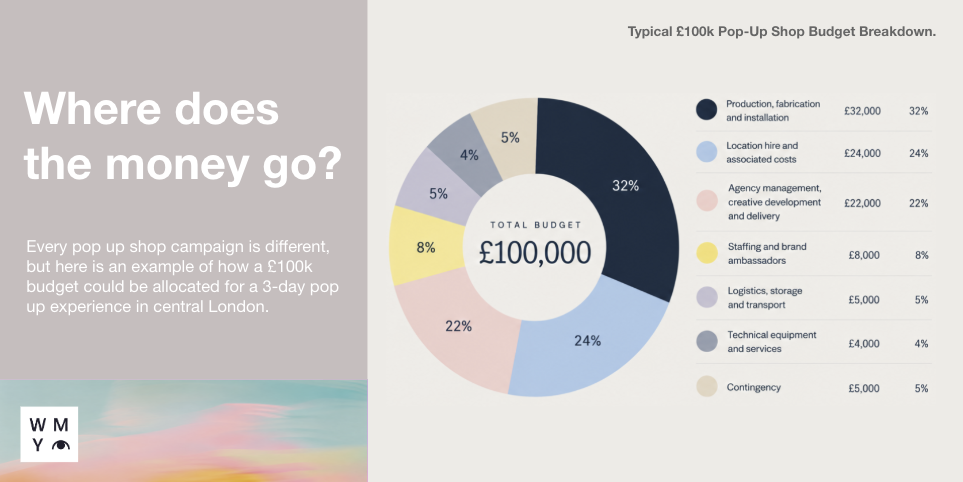
(these figures are illustrative, excluding VAT, and will vary considerably depending on the creative concept, location, production requirements and campaign objectives).
But the important question isn't simply how much each element costs. It's whether that investment is delivering the greatest possible value and delivering the right kind of experience for the brand.
The location trap.
One of the biggest decisions in experiential marketing is where geographically to activate. A prestigious central London location will consume a substantial proportion of the budget before a single element of the experience has been produced.
But does a more expensive location automatically deliver better results? In my experience it does not. A highly creative pop-up in a less obvious or slightly lower footfall location, supported by a compelling consumer promotion and intelligent marketing, outperforms an expensive high-footfall location every time.
The money saved on location hire can be redirected into better production, more engaging experiences or additional campaign days, thus increasing the ROI. Choosing a premium location can often be a case of vanity over sanity, or what feels like a less risky location strategy. The real measure of success is not the potential ‘eyeballs’ gained from high footfall, it is deeper engagement, greater content creation and ROI results that ‘shift the dial’. If these metrics are critical objectives and your budget is limited, then you need a destination-event strategy where fans seek you out rather than hoping to convert ‘the right’ audience in a high footfall location.
The costs brands don't always see.
Experiential budgets are complex, with many interconnected moving parts. A seemingly straightforward installation might require structural calculations, electrical certification, landlord approvals, overnight installation crews plus additional days hire for build and de-rig.
None of these elements are particularly exciting, but overlooking them during the initial budgeting process can create expensive problems later.
This is why thorough scoping matters. Before creative development progresses too far, an experienced agency should be challenging investment areas, identifying technical requirements and establishing realistic production parameters.
The objective isn't to eliminate every unforeseen cost. That's rarely possible in live environments. It's having the experience to anticipate challenges early enough that they can be managed without compromising the creative ambition or the brand's budget.
The agency margin question.
One area that deserves greater scrutiny is how agencies make their money. Traditional agency models normally include management fees PLUS hidden mark-ups on third-party production, staffing and supplier costs. These so-called hidden costs which agency’s closely guard are typically incur additional mark-up costs that range from 25%-45%.
There's nothing wrong with agencies making a profit. Expertise, accountability and experienced project management all have considerable value. The question is whether brands understand what they're paying for and are agencies being scrupulous and consistent, or are they making a ‘quick buck’ when the opportunity arises.
When production costs and agency remuneration are clearly separated, brands can make more informed decisions about what each of their agency partners are charging. It also creates a more collaborative relationship, where conversations focus on maximising the campaign rather than negotiating around unclear costs.
Transparency shouldn't be a radical idea. It should be a fundamental part of a trusted agency relationship. That is why We Made You Look have taken the decision to make all budgets totally transparent. No hidden mark-ups to give brands the confidence their budgets are being optimised and the agency-client relationship is grown based on trust and transparency.
The value of (agency) experience
Perhaps the most underestimated element of an experiential budget is the value of experienced decision-making. Knowing when a creative idea is becoming unnecessarily complicated. Recognising a production or operational risk before it becomes a problem. Understanding which elements audiences will genuinely notice and which can be simplified without compromising quality.
These decisions rarely appear as individual line items on a quotation, but they can have an enormous impact on the finished experience. A great experiential agency doesn't simply say ‘Yes’, it challenges the potential of the brief. It protects your budget, and constantly looks for opportunities to make the budget and experience work harder.
So, what should £100,000 really buy you?
It should buy more than a beautifully designed pop-up or a memorable brand moment.
It should buy creative ambition grounded in commercial reality. Experienced people making intelligent decisions. Complete confidence in where your money is going. And an experience that delivers against clearly defined objectives.
At We Made You Look, we believe exceptional creativity and commercial transparency should go hand in hand. Because ultimately, the measure of a great experiential campaign isn't how much you spend. It's what you achieve with it.
